3 Daily Steps
Lifelong Returns
TL;DR
Walking is one of the most accessible, scalable, and evidence-supported physical activity habits available. Increasing daily step volume is consistently associated with lower all-cause mortality, reduced cardiovascular risk, improved glucose regulation, stronger musculoskeletal integrity, enhanced cognitive performance, better mood stability, improved sleep quality, and more balanced inflammatory signaling. The relationship is dose-responsive within physiologic limits: more movement improves health up to a point.
The goal is not to chase an arbitrary number, but to begin where you are and apply progressive overload deliberately. Establish your baseline. Increase your step volume gradually. Track consistently. Integrate walking into routines that already exist in your life.
Small, repeated signals compound. Walking is not merely activity; it is applied physiology. This week, you increase the signal.
Introduction
The journey to lifelong health begins with a single step.
Among all the physical activity strategies discussed in this book, increasing your daily steps may be the most practical and powerful intervention available. It requires no gym membership, no specialized equipment beyond a pair of comfortable shoes, no technical skill, and no ideal conditions. It can be done at nearly any age, in almost any setting, and from virtually any level of fitness. Few strategies offer such accessibility with such profound return.
Health habits must fit into real lives, not ideal ones. That is a core principle of this approach. Effective habits are simple, accessible, and adaptable. They require minimal equipment, modest time, and flexible execution. They work whether you are highly active or just beginning again, and they scale as your capacity grows. Walking meets every one of those criteria.
Walking is foundational human movement. It is low-impact, scalable, sustainable, and profoundly effective. It improves cardiovascular health, enhances metabolic function, supports musculoskeletal integrity, and contributes meaningfully across physiologic systems, promoting both health and longevity. Few interventions offer such broad benefit with such a low barrier to entry.
The question is not whether walking works. The question is how much you should do, and how to increase it safely. There is no universal target. Step goals must be individualized to match your baseline activity, fitness level, comorbidities, occupational demands, overall health status, and personal goals. The aim is not punishment or arbitrary numbers, but the establishment of a sustainable, repeatable habit that builds health and capacity over time.
Whether you can already walk more or need to build toward it, increasing your walking capacity can measurably improve your health, fitness, and longevity.
In This Chapter
Walking: The Path for Health
Walking is not merely activity; it is a coordinated signal that prompts adaptation across the body’s major physiologic systems. As daily step volume increases, the body responds: cardiovascular efficiency improves, metabolic regulation tightens, musculoskeletal resilience strengthens, and cognitive and emotional stability benefit. These effects are not isolated but integrated, with each system adapting in concert.
Below, we walk through these effects system by system because adaptation is never confined to a single domain.
Cardiovascular System
The strongest and most consistent data linking daily step count to long-term health outcomes involve the cardiovascular system. Large observational analyses demonstrate that increasing daily step volume is associated with reductions in all-cause mortality, cardiovascular mortality, major adverse cardiovascular events, and new-onset type 2 diabetes.1–3
Multiple large cohort studies and meta-analyses evaluating daily step count and mortality demonstrate consistent, dose-responsive associations. In pooled analyses, each additional 1,000 steps per day was associated with approximately a 15% reduction in all-cause mortality (HR 0.85; 95% CI 0.81–0.91; P < 0.001). Even smaller increments mattered; an additional 500 steps per day was associated with a 7% reduction in cardiovascular mortality.1
The relationship appears dose-responsive across cardiovascular outcomes as well. Each additional 2,000 steps per day, up to approximately 10,000 steps, has been associated with a 10% reduction in cardiovascular event rates. In individuals with impaired glucose tolerance, increasing daily steps by 2,000 over a year was associated with approximately 8% lower cardiovascular event risk during follow-up.1,2
These are not surrogate markers or intermediate laboratory values. They represent outcome-based epidemiologic data: hard endpoints measured across large populations.
Mortality reduction is the most compelling outcome, but it is not the only one. Regular walking favorably modifies multiple cardiovascular risk parameters that precede those outcomes, including reductions in systolic and diastolic blood pressure, improvements in endothelial function, and enhanced arterial compliance, changes that reflect improved vascular health and reduced hemodynamic strain.
Walking also contributes to modest improvements in lipid profiles, including increases in HDL cholesterol and reductions in triglycerides.4 Resting heart rate declines with consistent aerobic activity, reflecting improved autonomic balance and cardiovascular efficiency. In patients with heart failure, structured walking programs improve functional capacity, exercise tolerance, and quality of life. Stroke risk is similarly reduced in individuals who maintain higher levels of habitual physical activity.
Because these data are derived from different populations and outcomes, the exact magnitude of risk reduction varies, but the direction is consistent: more daily steps are associated with lower cardiovascular risk.
- Lowers blood pressure
- Improves endothelial function
- Enhances arterial elasticity
- Modestly improves lipid parameters
- Reduces resting heart rate
- Improves functional capacity in heart failure
- Reduces stroke risk
Because cardiovascular disease remains the leading global cause of death, improvements across these physiologic parameters translate into meaningful gains in both lifespan and health span. The response is dose-responsive within physiologic limits: more movement improves health up to a point, after which benefit plateaus and excessive volume may impose cost. Even here, the foundational principle holds: the dose makes the poison.
Metabolic and Endocrine System
Walking exerts powerful metabolic effects, particularly in individuals with insulin resistance, prediabetes, or type 2 diabetes. Skeletal muscle is the largest site of glucose disposal in the body, and when it contracts during walking, two critical processes occur:
- Circulating glucose is used directly for energy.
- Glucose uptake into muscle cells increases through an insulin-independent pathway.
This means that walking lowers postprandial glucose not only by increasing energy expenditure but by activating an insulin-independent pathway of glucose uptake, a particularly powerful mechanism in individuals with insulin resistance.
A randomized crossover study comparing post-meal walking with a mealtime insulin injection in patients treated with basal insulin demonstrated that walking for 15–20 minutes after meals significantly reduced postprandial plasma glucose. Over an eight-week period, walking after three main meals daily resulted in a 0.9% absolute reduction in HbA1c in patients with type 2 diabetes.5 If HbA1c is 6.4%, a 0.9% decrease lowers it to 5.5%.
Even in individuals without diabetes, post-meal walking improves glycemic control, reduces glucose variability, enhances insulin sensitivity, and supports metabolic flexibility. In metabolic terms, a brief walk after eating is far more powerful than sitting.
Musculoskeletal System

Low back pain affected an estimated 619 million people globally in 2020 and remains the leading cause of disability worldwide. For many individuals, movement becomes something to avoid. Yet evidence suggests the opposite approach is often more effective.
Walking is not merely safe for most individuals with back pain; it is protective. In a randomized controlled trial, an individualized, progressive walking program combined with education nearly doubled the median time to recurrence, from 112 days in controls to 208 days in the intervention group.6 This finding reframes walking not simply as tolerated activity, but as a preventive strategy.
Beyond low back pain, habitual walking supports broader musculoskeletal integrity. Regular cyclic loading maintains joint mobility, promotes cartilage nourishment, and helps preserve bone density when performed consistently. Gait repetition enhances balance, neuromuscular coordination, and stability, all of which reduce fall risk over time.
- Maintains joint mobility
- Supports cartilage health through cyclic loading
- Preserves bone density
- Enhances balance and gait stability
Neurocognitive and Neurologic System

Regular walking supports neurologic health through multiple mechanisms. Aerobic movement increases cerebral blood flow, enhances oxygen delivery to neural tissue, and promotes neuroplastic adaptation. Higher habitual step counts have been associated with improved executive function, enhanced memory performance, faster processing speed, and greater attentional control.
Longitudinal data suggest that individuals who maintain higher levels of daily physical activity experience reduced rates of cognitive decline and a lower incidence of dementia over time.7 These associations are biologically plausible; aerobic activity stimulates the release of brain-derived neurotrophic factor (BDNF), a protein that supports neuronal survival, synaptic plasticity, and structural resilience within the brain.
Movement does not merely strengthen the body; it preserves and reinforces cognitive capacity. Regular walking actively promotes neural resilience and adaptive capacity across the lifespan while sharpening the mind.
Gastrointestinal and Metabolic Motility

Regular walking supports gastrointestinal motility and promotes more efficient digestion. Rhythmic movement stimulates peristalsis, enhances autonomic balance, and may reduce symptoms of bloating and constipation.
When performed after meals, walking further supports metabolic processing by improving glucose disposal and moderating postprandial glucose and insulin spikes. This effect is especially valuable in individuals with insulin resistance, where insulin signaling is impaired and post-meal glucose elevations are often exaggerated. These responses reflect coordinated interaction between the gastrointestinal and metabolic systems. Movement does not merely burn calories; it supports digestion.
Urologic and Reproductive Health
Vascular health influences more than the heart and brain. Regular physical activity, including walking, supports endothelial function and arterial integrity, factors that directly affect erectile function and broader urologic and reproductive health. Erectile dysfunction is often an early marker of vascular disease, and improvements in vascular performance frequently parallel improvements in sexual function.
Beyond sexual performance, habitual movement is associated with fewer lower urinary tract symptoms, healthier hormonal balance, and improved metabolic conditions that influence fertility and prostate health. Because vascular, metabolic, inflammatory, and hormonal pathways are shared across organ systems, gains in one domain often reinforce gains in others. Reproductive health is not separate from cardiovascular, metabolic, or neurologic health; it reflects the same underlying physiology expressed through a different lens. These shared pathways extend beyond vascular and hormonal systems; they include immune regulation and inflammatory balance as well.
Immune and Inflammatory Regulation

Moderate-intensity walking supports immune surveillance and helps regulate chronic low-grade inflammation. Unlike prolonged high-intensity exertion, which can transiently suppress immune function, consistent moderate movement strengthens immune competency over time.
Regular walking has been associated with reductions in pro-inflammatory cytokines, improvements in endothelial function, and better metabolic regulation, all of which contribute to a more balanced inflammatory profile. These effects are particularly meaningful given the central role of chronic inflammation in the development of cardiovascular disease, metabolic syndrome, neurodegeneration, and certain cancers.
Inflammation itself is not inherently harmful; it is essential for defense and tissue repair. The problem arises when it becomes persistent and dysregulated. Habitual movement helps recalibrate that response, restoring physiologic balance and modulating the long-term risk associated with chronic inflammatory states.
Cancer Risk and Oncologic Health

Higher levels of habitual physical activity, including regular walking, are consistently associated with a reduced risk of several cancers, most notably breast and colorectal cancer. The relationship appears dose-responsive up to a point: in general, more consistent weekly movement is associated with greater reductions in risk.8
The mechanisms are multifactorial. Regular walking improves insulin sensitivity, reduces chronic systemic inflammation, enhances immune surveillance, and supports more stable hormonal regulation, particularly within insulin and estrogen pathways that influence tumor biology. Improved metabolic control and reduced excess adiposity further contribute to a less cancer-prone internal environment.
Walking is not a treatment for cancer. But as part of a consistent lifestyle pattern, it meaningfully lowers risk by improving the internal conditions that allow malignant processes to take hold and progress. How you package the habit matters. Walking outdoors, in daylight, or with a friend has added health value and can increase the likelihood you will repeat it. Improved mood, reduced stress, and reinforced routine drive consistency, and consistency shifts the internal conditions that influence disease development over time.
Mental and Emotional Health

Regular walking is consistently associated with improved mood, greater emotional stability, reduced symptoms of anxiety and depression, and lower perceived stress. These effects are not incidental; they reflect measurable physiologic changes.
Aerobic movement stimulates endorphin release and supports autonomic balance by shifting the nervous system toward greater parasympathetic activity, enhancing recovery, emotional regulation, and resilience to stress. It also contributes to reductions in chronic low-grade inflammation, a factor increasingly implicated in mood disorders. When performed outdoors, walking adds exposure to natural light, reinforcing circadian rhythm regulation and emotional steadiness. Add fresh air, natural surroundings, or shared conversation, and the same walk becomes cardiovascular training, mood regulation, social connection, and cognitive reset, layered into one simple act.
Beyond biology, walking becomes structured psychological decompression, an opportunity for reflection, regulation, and mental clarity. The rhythmic, bilateral nature of sustained movement creates space for processing, perspective, and emotional recalibration.
Movement does more than condition the body; it stabilizes the mind. Regular walking builds emotional resilience the same way it builds physical capacity: through consistent, repeated signal over time.
Energy, Fatigue, and Sleep

Paradoxically, expending energy improves perceived energy. While inactivity may feel restorative in the short term, habitual movement enhances the body’s capacity to generate, regulate, and sustain energy more efficiently.
Regular walking supports mitochondrial function and improves metabolic efficiency at the cellular level. Over time, this translates into greater stamina, lower perceived exertion during daily tasks, and reduced baseline fatigue. Consistent movement also strengthens sleep-wake regulation, particularly when performed outdoors in natural light, aligning activity patterns with hormonal rhythms that govern recovery.
Improved sleep quality is one of the most reliable downstream effects of regular walking. Sleep becomes deeper and more consolidated, supporting hormonal balance, immune regulation, cognitive recovery, and tissue repair. Energy is not preserved by doing less; it is built through consistent, appropriately dosed movement. Sleep restores what movement stimulates, and together they compound adaptation across systems.
Integrated System

The body does not adapt in compartments. It adapts as an integrated system. When multiple systems improve simultaneously, cardiovascular, metabolic, musculoskeletal, neurologic, and emotional, longevity is not pursued directly; it emerges as a consequence. Walking does not target a single organ or isolated outcome. It delivers a coordinated physiologic signal across systems, prompting vascular adaptation, muscular strengthening, neural plasticity, modulation of inflammatory tone, and stabilization of hormonal balance. These responses accumulate over time, reinforcing one another and compounding into durable, system-wide adaptation.
Walking is foundational stimulus: simple in execution, scalable in application, and compounding in effect. It is applied physiology in motion.
The question now becomes practical: how much is enough, and how should you increase it safely?
How Many Steps Should You Aim For?
The popular 10,000-step target is culturally familiar, but it is not a biologic threshold. It originated from a 1960s Japanese marketing campaign for a pedometer, not from physiologic science. Health benefits occur well below that number, and the relationship between daily step count and mortality appears dose-responsive, with diminishing returns at higher volumes.
Large prospective cohort studies provide useful population-level reference ranges. In older women (mean age 72), mortality rates were substantially lower at approximately 4,400 steps per day compared with lower volumes, with risk continuing to decline up to roughly 7,500 steps per day before plateauing.9
In nationally representative U.S. adults, higher daily step counts were associated with progressively lower mortality risk, with meaningful reductions observed between approximately 7,000 and 10,000 steps per day.10
More recent pooled analyses confirm that each incremental increase in daily steps is associated with lower all-cause mortality across age groups, with benefits evident well below 10,000 steps per day.11
Earlier in this chapter, you saw that even small increases in daily steps are associated with lower mortality and cardiovascular risk. But the returns extend well beyond the heart. A 2025 analysis in The Lancet Public Health brought together evidence linking daily step counts with a broader range of health outcomes.12
Compared with approximately 2,000 steps per day, 7,000 steps per day was associated with 47% lower all-cause mortality, 25% lower risk of developing cardiovascular disease, and 47% lower cardiovascular mortality. Other findings were just as compelling: 37% lower cancer mortality, 14% lower risk of type 2 diabetes, 38% lower risk of dementia, 22% lower risk of depressive symptoms, and 28% lower risk of falls. These are relative differences observed across populations, not guaranteed personal results, and the strength of the evidence varied by outcome.12
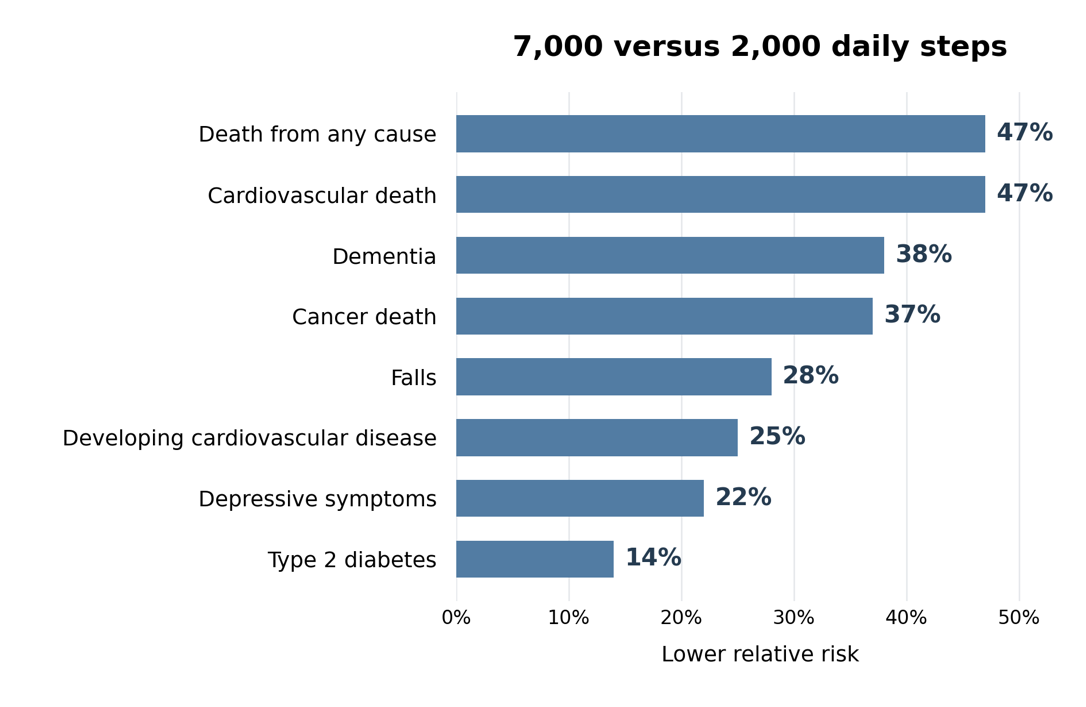
You do not have to reach 10,000 steps before your effort matters. For several outcomes, much of the benefit appeared as daily steps increased toward approximately 5,000–7,000, with additional benefits at higher totals for some outcomes. If you currently move very little, that is encouraging: increasing your daily movement may offer substantial returns well before you reach a familiar fitness target.12
Those outcome data show why increasing daily movement matters. The next question is more practical: what step count should you actually aim for? The guideposts below provide useful starting ranges rather than rigid targets.
| Population / starting point | Useful guidepost |
|---|---|
| Adults 18–64 | ~7,000–8,000 steps/day are associated with substantially lower mortality risk, with additional benefit observed up to around 10,000 steps. |
| Adults ≥65 | Mortality reductions are observed beginning around 4,000–6,000 steps/day, with continued benefit up to approximately 7,500–8,000 steps. |
| Sedentary individuals | Beginning at 3,000–5,000 steps/day and increasing gradually is a reasonable starting point. |
| Individuals with chronic conditions | Starting lower, even near 2,000 steps/day under medical supervision, may be appropriate. |
| Individuals with diabetes | Higher daily step counts are associated with improved insulin sensitivity and glycemic control when combined with dietary modification. |
These are population-level guideposts rather than rigid prescriptions. The most appropriate step target depends on baseline activity, age, health status, functional capacity, and individual goals.
These are not rigid targets. The right number is the one that meaningfully improves your health without exceeding your recovery capacity or competing with other essential demands of life. You begin where you are, and then you progress.
Progressive overload is a foundational training principle: adaptation occurs when the body is challenged slightly beyond its current baseline, then allowed to recover. The goal is not to leap to an arbitrary number, but to steadily expand capacity over time.
Establishing Your Baseline
Progress requires clarity. Before setting a target, you must understand where you are starting.
If you use a smartwatch or wearable device, review your longest available step-count average. Twelve months is ideal, six months is acceptable, and even one month provides a reasonable reference point. This average becomes your baseline, an objective snapshot of your current habitual movement.
If you are not currently tracking your steps, begin now. Measurement creates direction. Without it, change becomes guesswork.
From that baseline, improvement becomes deliberate. Nothing changes if nothing changes. Capacity increases when stimulus increases, thoughtfully, progressively, and safely.
Progression: Expand Without Breaking
Progression must be controlled. As a general principle in physical training, increases in workload should rarely exceed about 5% per week, a threshold that helps protect connective tissue, manage fatigue, and reduce injury risk. For daily step volume, however, I recommend moving even more conservatively. In most individuals, increasing your average daily step count by approximately 5% per month is safer and more sustainable, particularly if you are rebuilding fitness, managing chronic conditions, or balancing other forms of training. The precise rate should reflect your current fitness level, recovery capacity, and total life load. Progress is individualized; the goal is steady expansion of capacity, not abrupt escalation.
For example, if your baseline is 6,000 steps per day, a 5% increase brings your new target to roughly 6,300 steps per day. Sustained and compounded monthly, that gradual rate of increase would place you above 10,000 steps per day over the course of a year, achieved without abrupt strain, excessive fatigue, or unnecessary injury risk.
Where you are now is a data point, not a destination. The body requires time to adapt. Connective tissue strengthens gradually, muscular endurance builds incrementally, and cardiovascular efficiency improves through repeated stimulus. Progressive overload respects biology by expanding capacity without overwhelming recovery.
These increases may appear small, but consistency compounds. Modest increments layered over time produce meaningful change. Progression does not continue indefinitely; at some point, growth transitions to maintenance. Your targets must reflect your total life load: cycling, swimming, resistance training, occupational demands, sleep, and family responsibilities. Volume must remain balanced.
The goal is not maximal volume, but sustainable adaptation.
Tracking and Accountability
Tracking transforms intention into behavior. Without measurement, there is no feedback; without feedback, there is no adjustment.
Use whatever system ensures consistency. A smartwatch or wearable app is efficient and automated. A spreadsheet provides visibility and trend analysis. A notebook or shared digital document can be equally effective if used consistently. The tool matters less than the discipline of recording and reviewing your progress.
A spreadsheet offers particular advantages: it allows you to add activities, update monthly averages, adjust goals progressively, and archive older columns as your data accumulate. Over time, this creates a clear visual record of upward momentum.
Sharing your progress with an accountability partner further strengthens adherence. Most individuals plateau eventually; this is expected. When that occurs, maintenance becomes the objective. The goal is not indefinite escalation, but sustained consistency.
Simple Ways to Increase Your Steps
Increasing step volume does not require dramatic lifestyle change. It requires intentional integration.
Walking is a powerful example of stacked benefits: one simple behavior can improve multiple domains simultaneously. A single walk can strengthen the cardiovascular system, regulate glucose, reinforce circadian rhythm through sunlight exposure, reduce stress through parasympathetic activation, and deepen social connection when done with a friend.
When one action improves more than one system, adherence improves, and impact compounds.
Rather than adding walking as an isolated task, attach it to behaviors you already perform. Integration is more sustainable than addition.
- Walk after meals
- Take stairs instead of elevators
- Park farther from entrances
- Walk during phone calls
- Schedule walking meetings
- Walk your dog consistently
- Add social walks with friends or family
- Walk while waiting (appointments, practices, events)
- Protect a daily non-negotiable walking window
The goal is not disruption. It is alignment. Walking should fit into your life, not compete with it.
Deliberately increase your daily step baseline and build sustainable upward momentum.
Determine your baseline step average using your longest available data range.
Set a target 5% above that baseline to sustain for the next month.
Walk at least 10–15 minutes after one meal daily.
Track your steps every day.
This is not about perfection. It is about directional change. Protect the habit. Let the compounding begin.
Walking is foundational human movement: low-tech, accessible, and profoundly effective. It improves longevity, reduces cardiovascular risk, enhances glucose regulation, protects musculoskeletal integrity, and stabilizes mood. It does not require ideal conditions; it requires repetition. What makes walking powerful is not intensity but consistency. It is scalable, measurable, and sustainable across decades. Small increases accumulate, and repeated signals compound.
In earlier chapters, you learned to track your Active Calories and understand basal metabolism. Here, you reinforce that system with volume, not by pushing harder, but by moving more often. Physiology responds to use. When you increase the signal, the system adapts.
This week, you begin that expansion, one deliberate step at a time.
And in the next chapter, we increase the demand, and you begin to climb.
For educational purposes only. This information is not a substitute for individualized medical advice. Read the Health Disclaimer.
References
- Banach M, Lewek J, Surma S, et al. The association between daily step count and all-cause and cardiovascular mortality: a meta-analysis. Eur J Prev Cardiol. 2023;30(18).
- Kraus WE, Janz KF, Powell KE, et al. Daily Step Counts for Measuring Physical Activity Exposure and Its Relation to Health. Med Sci Sports Exerc. 2019;51(6).
- Soares-Miranda L, Siscovick DS, Psaty BM, Longstreth W, Mozaffarian D. Physical Activity and Risk of Coronary Heart Disease and Stroke in Older Adults: The Cardiovascular Health Study. Circulation. 2016;133(2).
- Franczyk B, Gluba-Brzózka A, Ciałkowska-Rysz A, Ławiński J, Rysz J. The Impact of Aerobic Exercise on HDL Quantity and Quality: A Narrative Review. Int J Mol Sci. 2023;24(5).
- Suntornlohanakul O, Areevut C, Saetung S, Ingsathit A, Rattarasarn C. Glycemic effect of post-meal walking compared to one prandial insulin injection in type 2 diabetic patients treated with basal insulin: A randomized controlled cross-over study. PLoS One. 2020;15(4).
- Pocovi NC, Graham PL, Lin CWC, et al. Effectiveness and cost-effectiveness of a progressive, individualised walking and education program for prevention of low back pain recurrence in adults: statistical analysis plan for the WalkBack randomised controlled trial. Trials. 2023;24(1).
- Liao Q, He J, Huang K. Physical activities and risk of neurodegenerative diseases: A two-sample Mendelian randomization study. Front Aging Neurosci. 2022;14.
- Holmes MD, Chen WY, Feskanich D, Kroenke CH, Colditz GA. Physical activity and survival after breast cancer diagnosis. JAMA. 2005;293(20).
- Lee IM, Shiroma EJ, Kamada M, Bassett DR, Matthews CE, Buring JE. Association of Step Volume and Intensity with All-Cause Mortality in Older Women. JAMA Intern Med. 2019;179(8).
- Saint-Maurice PF, Troiano RP, Bassett DR, et al. Association of Daily Step Count and Step Intensity with Mortality among US Adults. JAMA. 2020;323(12).
- Rodríguez-Gutiérrez E, Torres-Costoso A, del Pozo Cruz B, et al. Daily steps and all-cause mortality: An umbrella review and meta-analysis. Prev Med. 2024;185:108047.
- Ding D, Nguyen B, Nau T, et al. Daily steps and health outcomes in adults: a systematic review and dose-response meta-analysis. Lancet Public Health. 2025;10(8).