7 Strength Training
Use It or Lose It
TL;DR
Strength and power are foundational to independence, cardiometabolic health, bone and joint integrity, fall prevention, and longevity. While muscle mass may influence appearance, it is functional strength, and the ability to generate force efficiently and rapidly, that predicts resilience, resistance to chronic disease, and long-term survival.
Consistent strength training is associated with lower risk of all-cause mortality and major chronic disease, but the benefits follow a nonlinear pattern. For most people, training the major muscle groups at least twice per week can provide substantial benefits for muscle, bone, metabolic health, physical function, and long-term health. Effective training is not about complexity. It is about applying simple principles consistently over time.
Introduction
In the previous chapters, you began rebuilding movement from the ground up. Walking expanded your daily volume, stairs added intensity, and movement snacks improved the distribution of activity throughout the day. Most recently, joint care restored mobility, reducing stiffness, improving posture, and making movement smoother and more available. The hinges are no longer tight. The system is ready to build.
Strength is one of the most perishable qualities of the human body. If you do not use it, you lose it—quietly, steadily, and often without noticing until everyday tasks begin to feel heavier than they once did.
Those earlier habits prepared the terrain. Strength training builds upon that foundation, developing the capacity that allows the body to tolerate and sustain movement while producing functional strength and power.
This chapter introduces the biological and practical foundations of strength and power training. In the chapters that follow, we will organize that work into a simple and durable framework: Push, Pull, and Legs. Push movements primarily train the upper-body muscles used to press resistance away from you, including the chest, shoulders, and triceps. Pull movements primarily train the muscles that draw resistance toward you, particularly the back, biceps, and forearms. Legs encompass the major muscle groups and movement patterns of the lower body. Before applying that structure, however, it is important to understand why strength matters, how it changes with age, the cost of losing it, and how little training is required to begin realizing its benefits.
Some people assume strength training becomes less important with age or that it carries unnecessary risk. The opposite is true. When performed with proper form and thoughtful progression, strength and power training can enhance mobility, resilience, confidence, and physical capacity.
This is not about aesthetics. It is about durability.
In This Chapter
Understanding Strength, Power, and Muscle Mass
Before we go further, we need to clarify what we are actually building. Strength, power, and muscle mass are often used interchangeably, yet they represent distinct physiological qualities. The distinction matters because the benefits we seek—independence, resilience, and longevity—are driven more by function than appearance. We often equate larger muscles with strength, and while there is a clear association, the two are not synonymous. To appreciate how strength and power training influence health and longevity, it helps to define these terms clearly.
These qualities overlap, but they are not interchangeable. Muscle mass may correlate with strength, yet it does not independently predict survival the way strength does. Functional capacity matters more than appearance. Power declines even more rapidly with aging than strength, making it an especially important quality to preserve.
This distinction has practical consequences. Research in older adults shows that muscle power is often more strongly associated with functional performance than maximal strength alone.1 Activities such as rising from a chair, climbing stairs, or catching yourself after a stumble require force to be produced quickly. As a result, preserving the ability to generate power may be particularly important for maintaining mobility, preventing falls, and sustaining independence with age.
What Happens When Strength Declines
Without intentional training, aging follows a predictable trajectory. The losses are measurable and progressive:
- Muscle mass decreases approximately 3–8% per decade.
- Strength declines approximately 5–15% per decade.
- Power falls even more steeply, by 20–30% per decade.
Power declines first and fastest because Type II fast-twitch muscle fibers, which are responsible for rapid, explosive movement, are lost and shrink more rapidly with age. This helps explain why older adults often lose the ability to catch themselves during a fall. It is not muscle size they are missing—it is rapid force production.
Left unaddressed, the combined decline in muscle mass, strength, and power contributes to sarcopenia, progressive bone loss, increased fall risk, metabolic dysfunction, and ultimately loss of independence.
Strength and power training interrupts that trajectory.
Why Functional Strength Predicts Longevity
Large population studies reinforce the distinction between muscle size and functional strength. In an analysis of 4,449 adults aged 50 years and older from the National Health and Nutrition Examination Survey (NHANES)—a nationally representative U.S. cohort followed for nearly eight years—low muscle strength was associated with a 2–2.6-fold higher risk of all-cause mortality, independent of muscle mass.2 In other words, individuals with weaker muscles were roughly two to two-and-a-half times more likely to die during follow-up, even after accounting for how much muscle they had.
Importantly, this association remained consistent across varying levels of metabolic syndrome, sedentary behavior, and leisure-time physical activity. Muscle mass alone did not demonstrate the same predictive power.
These findings are supported by a meta-analysis of 38 studies involving nearly two million participants.3 Across diverse populations and follow-up periods, higher levels of both upper- and lower-body muscular strength were consistently associated with reduced mortality risk. Individuals with greater handgrip strength demonstrated approximately a 31% lower risk of all-cause mortality, with the protective association appearing even stronger in women, approaching 40%. Higher lower-body strength was also protective, corresponding to roughly a 14% reduction in mortality risk.
The pattern is consistent: muscular strength predicts survival. Muscle size alone does not. Function matters more than appearance.
Even more compelling, relative strength (strength adjusted for body weight) appears to correlate more strongly with metabolic health and quality of life than absolute strength values.4 This reinforces an important principle: it is not how large the muscle appears, but how effectively it functions relative to the demands placed upon the body. We are not chasing hypertrophy for its own sake. We are building functional strength—the kind that preserves independence, protects against disease, and sustains resilience over time.
The epidemiology is clear: strength predicts survival. The next question is why. What is it about strength and power that influences longevity across so many conditions?
Strength training influences health across multiple physiologic systems simultaneously. Rather than acting through a single pathway, resistance training produces coordinated adaptations across muscular, metabolic, cardiovascular, structural, and psychological domains.
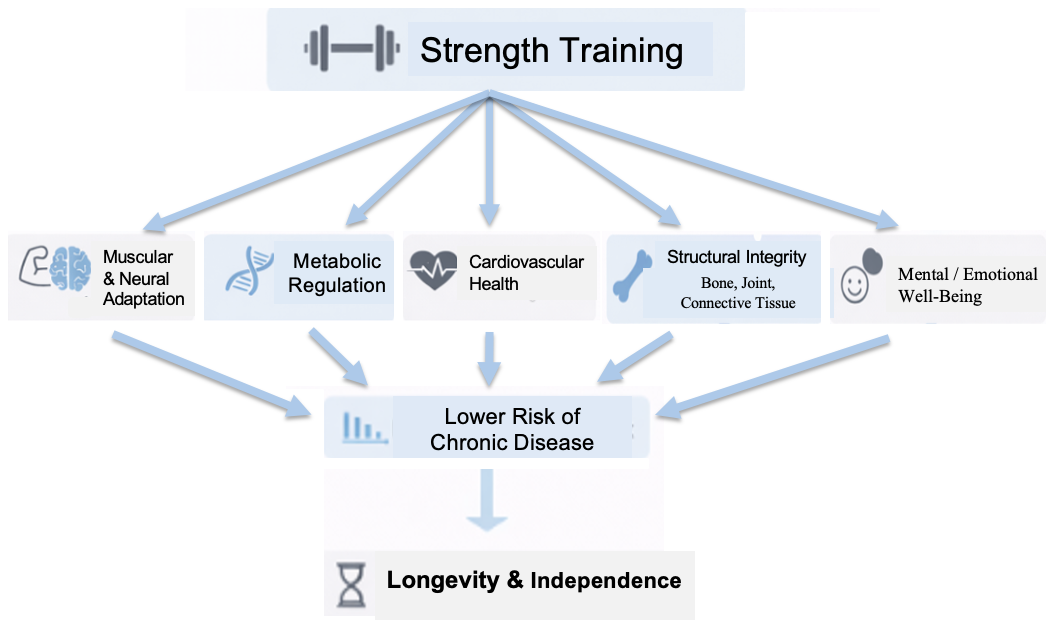
How Strength Training Influences Major Physiologic Systems
The data help explain why. The broad physiologic influence of strength is what makes it such a powerful determinant of long-term health and survival. As strength and power decline, the effects extend far beyond muscle tissue, influencing cardiovascular regulation, metabolic health, skeletal integrity, neurologic resilience, cancer risk, and ultimately overall health and longevity. Strength training therefore functions as a systemic intervention rather than an isolated muscle fitness modality. Several of these system-level effects are highlighted below.
Cardiovascular
Low muscular strength is associated with increased cardiovascular mortality, while participation in muscle-strengthening activities is associated with approximately a 17% lower risk of cardiovascular disease.5 Strength training improves blood pressure regulation, enhances lipid profiles, increases insulin sensitivity, and supports vascular function.
Importantly, the relationship is nonlinear. Moderate, consistent training confers substantial benefit, whereas excessive volume does not appear to provide additional protection and may diminish returns. The goal is not maximal loading—it is optimal adaptation.
Metabolic / Endocrine
Skeletal muscle functions as metabolic infrastructure. As strength declines, glucose disposal becomes less efficient, insulin resistance increases, and metabolic risk accumulates. Strength training improves insulin sensitivity, enhances glucose uptake, and is associated with approximately a 30% lower incidence of type 2 diabetes.5 It modestly increases basal metabolic rate (BMR), but more importantly, it restores metabolic responsiveness and reduces chronic disease risk.
Muscle is not just cosmetic tissue—it is metabolic and endocrine tissue.
Musculoskeletal (Bone, Connective Tissue, Stability)

Without regular loading, bone density declines with age, with a more pronounced decline in women after menopause as estrogen levels fall. Progressive resistance training provides a mechanical stimulus that can help preserve or improve bone mineral density, including at clinically important skeletal sites such as the lumbar spine and femoral neck.6
Tendons and other connective tissues also adapt to repeated mechanical loading. Resistance training can increase tendon stiffness and improve the mechanical properties of the muscle-tendon unit, supporting its ability to transmit force.7
Resistance training also improves neuromuscular function, balance, gait, and multiple measures of physical performance.8 Together, these adaptations help preserve movement capacity and may contribute to lower fall risk as we age.
Strength is not merely about lifting weight. It is about preserving structural integrity and movement competency. These adaptations create the foundation for balance, coordinated movement, and the ability to generate force safely in everyday life.
Neurocognitive / Neurologic

Resistance training has been associated with improvements in executive function, processing speed, and cognitive resilience, along with reductions in depressive symptoms.9 Multiple mechanisms may contribute, including neuroplastic signaling, cerebrovascular effects, and improved self-efficacy. Producing force against resistance reinforces agency. Strength training reminds the nervous system that it is capable.
Cancer Risk & Oncologic Health

Muscle-strengthening activity is associated with approximately a 9% reduction in cancer mortality.5 The protective effect likely reflects improvements in metabolic regulation, systemic inflammation, immune function, and body composition rather than a direct oncologic mechanism.
Mental & Emotional Health

Beyond measurable neurocognitive benefits, resistance training reduces depressive symptoms and may support mood regulation and perceived resilience.9 Strength training can be psychologically stabilizing. It builds confidence through capability.
Energy, Fatigue, and Sleep

As strength increases, daily activities demand a smaller percentage of available capacity. Tasks feel easier, and perceived energy may improve. Regular resistance training can also support sleep quality and recovery, particularly when it improves overall physical capacity and reduces the relative effort required for everyday tasks.
When strength rises, fatigue decreases not because life becomes lighter, but because you are stronger relative to its demands.
Integrated System Effect

It should come as no surprise that these adaptations do not occur independently. Improvements in muscular strength enhance metabolic control; better metabolic control reduces cardiovascular strain; improved cardiovascular health supports cognitive function; stronger bones and connective tissue reduce injury risk, preserving activity levels. Each system reinforces the others.
This stacking effect explains why modest, consistent strength training produces disproportionate long-term benefit and influences nearly every major physiologic domain. Strength training is not an isolated muscular fitness modality—it is a systems-level investment in health and resilience.
From Mechanism to Application
Understanding that strength predicts survival and influences nearly every major physiologic system naturally raises a practical question: how should we train to capture these benefits efficiently and safely?
Before moving into specific movement patterns, it is important to recognize that strength is rarely expressed in isolation. In daily life, force is produced through coordinated actions—pushing, pulling, lifting, rising, and carrying. The body functions through patterns, not isolated muscles. For this reason, the most effective strength programs emphasize compound movements that train multiple muscle groups simultaneously.
That reality is what drives the Push–Pull–Legs structure used in the next three chapters. Rather than organizing training around a collection of individual muscles, we will organize it around fundamental movement patterns that reflect how the body actually works. To do that effectively, we must understand how different training variables influence adaptation.
Key Principles for Effective Strength Training
Before moving into specific exercises, it is important to understand how effective training actually works. Strength does not come from complexity, but from consistency over time.
These principles will guide every strength habit that follows.
Compound vs. Isolation Movements
Strength training exercises can broadly be divided into compound and isolation movements.
Compound movements involve multiple joints and muscle groups working together. Examples include squats, deadlifts, presses, and rows. Because they recruit large amounts of muscle simultaneously, compound exercises efficiently develop functional strength and reflect the coordinated actions used in everyday life—pushing, pulling, lifting, rising, and carrying.
Isolation movements, in contrast, primarily involve a single joint and target a specific muscle group. Exercises such as leg extensions, biceps curls, or lateral raises can be useful for correcting imbalances, supporting rehabilitation, or adding targeted muscle development after compound work.
Most effective strength-training programs emphasize compound movements as the foundation of training because they develop integrated strength across multiple muscle groups while closely mirroring real-world movement demands. Isolation exercises are then used selectively to complement these foundational movements.
How Load and Repetition Shape Adaptation
Strength training improves health because it changes how muscle and the nervous system adapt to mechanical load. How that load is applied—specifically the amount of weight used and the number of repetitions performed—shapes the type of adaptation that occurs.
Strength is the capacity to produce maximal force. Power combines force with speed. Hypertrophy refers to increases in muscle size. These qualities overlap, but the training stimulus used to emphasize each can differ.
Strength: Heavier loads, typically in the range of about 80–100% of one-repetition maximum (1RM), performed for lower repetitions (roughly 1–5 per set), tend to preferentially increase maximal strength.
Power: For power development, the 2026 American College of Sports Medicine (ACSM) Position Stand supports moderate loads of approximately 30–70% of 1RM performed with maximal intended speed during the lifting phase.8 This ability to generate force quickly becomes particularly important with aging, when rapid force production is needed to stabilize balance, recover from a stumble, or rise from a chair.
Hypertrophy: Moderate loads performed for moderate repetition ranges (often around 6–15 repetitions per set) are commonly used for hypertrophy, although muscle growth can occur across a broader range of loads when training provides sufficient effort and weekly volume.10
These distinctions are not rigid boundaries. Adaptation exists on a spectrum, and both strength and hypertrophy can improve across a wide range of repetition schemes, particularly when sets are performed close to muscular fatigue. However, load appears to be an important driver of maximal strength development. In practical terms, if your goal is to build strength, lifting relatively heavy weight, safely and progressively, matters.
| Aspect | Strength | Power | Muscle Mass (Hypertrophy) |
|---|---|---|---|
| Definition | Ability to exert maximal force against resistance | Ability to generate force rapidly (rate of force development) | Physical size and volume of muscle tissue |
| Training focus | Maximal force production | Explosive force production | Increasing muscle size |
| Typical volume | Low (1–5 reps) | Low–moderate repetitions, performed explosively | Commonly ~6–15 reps near muscular fatigue; broader ranges can be effective |
| Typical intensity | High (≈80–100% of 1RM) | Moderate (≈30–70% of 1RM) with maximal speed | Moderate (≈65–80% of 1RM) |
| Rest periods | Long (3–5 minutes) | Moderate (2–3 minutes) | Short–moderate (60–120 seconds) |
| Exercise selection | Compound movements (e.g., squats, deadlifts, presses) | Explosive movements (e.g., Olympic lifts, jumps, medicine-ball throws) | Mix of compound and isolation exercises |
1RM = the maximum weight that can be lifted for one repetition. These ranges are practical guides, not rigid boundaries.
A useful way to visualize these relationships is through the strength–endurance continuum. Rather than representing rigid categories, the continuum illustrates how different loading strategies shift the emphasis of adaptation. At one end are heavy loads performed for low repetitions that emphasize maximal strength. At the other end are lighter loads performed for higher repetitions that emphasize muscular endurance, with hypertrophy and power adaptations occurring across the middle ranges.
While real-world adaptations are more fluid than any diagram suggests, the continuum provides a practical framework for aligning training intent with outcome.
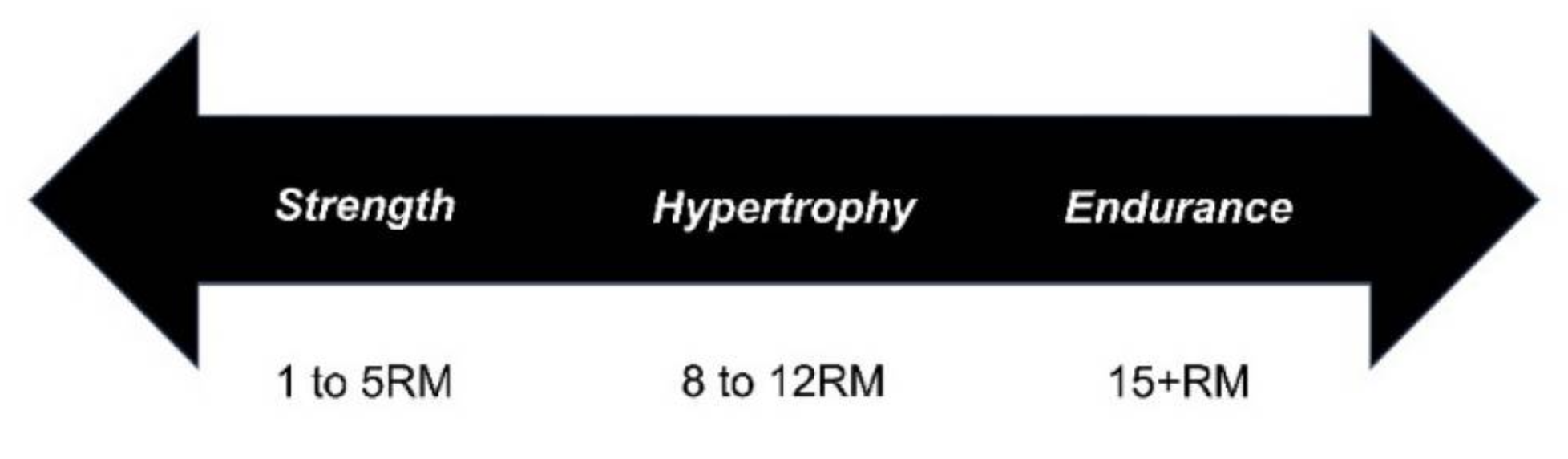
The Optimal Dose: How Much Is Enough
Most physiologic systems respond to training in a predictable way: too little stimulus produces minimal adaptation, while excessive exposure may reduce benefit or introduce new risk. Strength training follows this same pattern.
One of the most consistent findings in the literature is that strength training demonstrates a nonlinear dose–response relationship, meaning that moderate levels of training provide the greatest long-term health benefit.
The meta-analysis referenced earlier demonstrated a nonlinear association between time spent in muscle-strengthening activity and mortality risk.5 The lowest relative risk for all-cause mortality occurred at approximately 40 minutes per week. For cardiovascular disease, the lowest risk appeared around 60 minutes per week. Cancer mortality showed benefit near 30 minutes per week, while diabetes risk continued to decline with somewhat greater exposure.
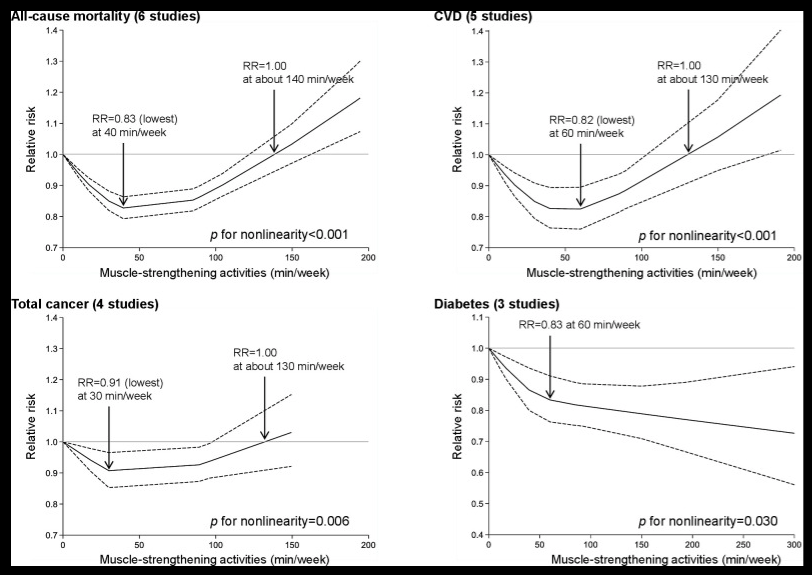
The figure illustrates the nonlinear relationship between time spent performing muscle-strengthening activity and risk across several major health outcomes. Relative risk declines rapidly with modest training exposure, reaching its lowest levels at approximately 30–60 minutes per week for most outcomes. Beyond this range, additional training provides diminishing returns for several conditions, with risk gradually returning toward baseline at higher training volumes. Diabetes risk appears somewhat different, continuing to decline with greater activity levels.
- All-cause mortality: approximately 17% lower risk, lowest risk near 40 minutes per week
- Cardiovascular disease: approximately 18% lower risk, lowest near 60 minutes per week
- Total cancer: approximately 9% lower risk, lowest near 30 minutes per week
- Diabetes: approximately 17% lower risk near 60 minutes per week, with continued benefit as training time increases
These findings reinforce a central principle: meaningful health benefits arise from moderate, consistent strength training rather than extreme training volumes.
It is important to distinguish the amount of strength training associated with health and longevity from the amount that may optimize strength, muscle growth, or athletic performance. Epidemiologic studies suggest that relatively modest amounts of weekly muscle-strengthening activity are associated with meaningful reductions in chronic disease and mortality risk. Training designed to maximize strength, power, or muscle development may require greater volume depending on the individual and the goal.
For general health, meaningful benefits can occur with surprisingly modest amounts of strength training. A practical goal for many adults is to train the major muscle groups at least twice per week, with total training time varying according to goals, experience, exercise selection, and recovery. More is not necessarily better. The priority is consistent, progressive training that can be sustained over time.
Practical Training Structure
With this general range in mind, the next question becomes how to organize strength training in practice.
For general health, a practical starting point is two strength-training sessions per week. Organize them around simple, repeatable movement patterns: upper-body pushing, upper-body pulling, and lower-body training. Total training time can vary according to your goals, experience, exercise selection, and recovery.
A simple and effective framework looks like this:
- Train two times per week as a practical starting point.
- Emphasize compound push, pull, and leg movements.
- Choose loads and repetition ranges appropriate to your goals and experience.
- For general strength development, two to three working sets per movement is a reasonable place to begin.
- Space challenging sessions across the week so the major muscle groups have time to recover between them.
Compound movements such as squats, presses, rows, and deadlifts form the foundation because they develop integrated strength across multiple muscle groups. Isolation movements can be used selectively for balance or rehabilitation, and explosive variations can be incorporated to train power where appropriate. This structure also allows room for complementary training such as core work and endurance. Stacking these benefits increases the return on your time and effort, which matters because most people are busy and time is limited. Make each session count.
Consistency, progression, and recovery matter more than complexity.
Individualizing Your Training Program
No program is universally correct. The exercises you choose should reflect your individual goals, injury history, movement competency, recovery capacity, and available equipment. A balanced approach remains essential. Strength and power training should complement balance, flexibility work, and endurance, not replace them. These components will be explored in greater detail in the chapters that follow.
Gradually increase resistance, repetitions, or total work over time while maintaining proper technique. You do not need to change exercises on a fixed schedule. Keep a routine long enough to develop skill and track progress, then adjust the exercise, load, volume, or recovery when progress stalls, fatigue accumulates, or your goals change.
The science is not perfectly settled on exact repetition ranges or percentages, and meaningful gains can occur across a spectrum of approaches. What remains consistent are a few core principles:
- Progressive overload builds strength.
- Appropriate load drives adaptation.
- Consistency produces long-term benefit.
The specific exercises you choose should be tailored to your individual needs and goals. Many people benefit from guidance from a qualified coach or trainer, while others may prefer to research and structure their programs independently. While there is no single perfect approach, there is an abundance of reliable information available to help you develop an effective training plan. The key is to begin, progress gradually, and remain consistent over time.
Practical Training Principles
Several practical strategies help apply these principles effectively in day-to-day training.
Track your training: Record exercises, weights, repetitions, and sets. Tracking provides a clear reference for progression and helps guide gradual increases over time.
Progress gradually: Increase weight, repetitions, or total work in small, steady steps. Consistent progression, not rapid escalation, drives long-term adaptation.
Introduce variation when it serves a purpose: You do not need to continually change exercises to make progress. Consistency allows you to practice movement, measure improvement, and apply progressive overload. Adjust your program when progress stalls, fatigue accumulates, an exercise no longer fits your goals, or a different movement better suits your needs. More experienced lifters may also use planned periods of reduced training (“deloads”) to manage fatigue, but these are tools, not requirements.
More structured variation is sometimes called periodization: the planned adjustment of training variables such as load, volume, or frequency over time. Periodization can be useful for experienced lifters, athletes, or people preparing for specific performance goals, but it is not required for most people to become stronger. Consistent training and progressive overload remain more important than following a complicated training cycle.
These strategies help maintain progress while reinforcing the core principles of consistency, progression, and recovery.
Keep the structure simple. Perform two strength-training sessions this week built around three basic patterns: an upper-body push, an upper-body pull, and a lower-body movement. Choose a manageable resistance and focus first on controlled movement and good technique.
- Push: push-up, chest press, or overhead press
- Pull: row, pulldown, or assisted pull-up
- Legs: squat, chair stand, or lunge
Two or three working sets of each movement is enough to begin. If you are new to strength training, start light and focus on learning the movements with excellent form. If you already have experience, reestablish consistency or gradually increase the load within your current routine.
Track your sessions. Record the exercises performed, the weight used, the repetitions completed, and how you felt. Your goal is initiation, not perfection. That is enough to begin changing the trajectory.
Strength and power training are not aesthetic pursuits. They are structural investments in durability. They preserve independence, protect against chronic disease, maintain bone and joint integrity, and reinforce resilience.
When strength is present, daily tasks require less effort. Balance improves. Falls are less likely. Metabolic control is stronger. Recovery is faster. The body becomes more capable relative to the demands of daily life. Equally important is power—the ability to produce force quickly—which allows the body to respond to sudden demands such as catching a misstep, rising from a chair, or stabilizing during a fall.
This is not about extremes. It is about preservation and capacity. A modest, consistent commitment to strength training at least twice per week can meaningfully improve strength, function, and long-term physical capacity. Train with control, progress gradually, and remain consistent over time.
With this foundation in place, the next three chapters translate principle into practice. You will learn how to push with control, pull with stability, and build legs that support strength, balance, and movement over time. Now we build.
For educational purposes only. This information is not a substitute for individualized medical advice. Read the Health Disclaimer.
References
- Reid KF, Fielding RA. Skeletal muscle power: A critical determinant of physical functioning in older adults. Exerc Sport Sci Rev. 2012;40(1):4–12.
- Li R, Xia J, Zhang X, et al. Associations of Muscle Mass and Strength with All-Cause Mortality among US Older Adults. Med Sci Sports Exerc. 2018;50(3):458–467.
- García-Hermoso A, Cavero-Redondo I, Ramírez-Vélez R, et al. Muscular Strength as a Predictor of All-Cause Mortality in an Apparently Healthy Population: A Systematic Review and Meta-Analysis of Data From Approximately 2 Million Men and Women. Arch Phys Med Rehabil. 2018;99(10):2100–2113.e5.
- Chun SW, Kim W, Choi KH. Comparison between grip strength and grip strength divided by body weight in their relationship with metabolic syndrome and quality of life in the elderly. PLoS One. 2019;14(9):e0222040.
- Momma H, Kawakami R, Honda T, Sawada SS. Muscle-strengthening activities are associated with lower risk and mortality in major non-communicable diseases: a systematic review and meta-analysis of cohort studies. Br J Sports Med. 2022;56(13):755–763.
- Feng H, Xie ZW, Wang Y, Zhang Y, Zuo H, Yang H. Effectiveness of different exercise types for improving bone mineral density in adults: A pairwise, network, and dose-response meta-analysis of 162 randomized controlled trials. Bone. 2026;213:118044.
- Lazarczuk SL, Maniar N, Opar DA, et al. Mechanical, Material and Morphological Adaptations of Healthy Lower Limb Tendons to Mechanical Loading: A Systematic Review and Meta-Analysis. Sports Med. 2022;52(10):2405–2429.
- Currier BS, D’Souza AC, Singh MAF, et al. American College of Sports Medicine Position Stand. Resistance Training Prescription for Muscle Function, Hypertrophy, and Physical Performance in Healthy Adults: An Overview of Reviews. Med Sci Sports Exerc. 2026;58(4):851–872.
- Gordon BR, McDowell CP, Hallgren M, Meyer JD, Lyons M, Herring MP. Association of Efficacy of Resistance Exercise Training With Depressive Symptoms: Meta-analysis and Meta-regression Analysis of Randomized Clinical Trials. JAMA Psychiatry. 2018;75(6):566–576.
- Schoenfeld BJ, Grgic J, Van Every DW, Plotkin DL. Loading Recommendations for Muscle Strength, Hypertrophy, and Local Endurance: A Re-Examination of the Repetition Continuum. Sports (Basel). 2021;9(2):32.