
Read the Label, Not the Marketing
Understanding Nutrition Labels
TL;DR
The Nutrition Facts label is one of the simplest and most practical tools you can use to make better food choices. Start with the serving size, because every other number on the label depends on that amount. Calories matter, but they are only one part of the story. Pay attention to what those calories provide by looking at protein, dietary fiber, added sugars, saturated fat, sodium, and the ingredient list. Use Percent Daily Value (%DV) as a quick way to compare similar foods, but don't get caught up trying to optimize or memorize every number.
Most importantly, don't let the marketing on the front of the package make the decision for you. Claims such as "natural," "organic," "multigrain," or "high protein" may highlight one feature of a product, but they rarely tell the whole story. Turn the package over, read the Nutrition Facts label and ingredient list, and let the complete nutritional picture guide your decision. Like many of the habits in this program, reading a nutrition label takes only a few moments but can help you make better food choices for years to come. Read the label, not the marketing. It may be one of the simplest health habits you ever develop.
Introduction
Walk through almost any grocery store, spend a few minutes watching television, or scroll through social media, and you'll quickly notice how often food is marketed as healthy. Packages and advertisements promote products as “natural,” “high protein,” “multigrain,” “made with whole grains,” “low fat,” or “no added sugar.” Some of these claims provide useful information, but others tell only part of the story or create a healthier impression than the product may deserve. The most useful information is often not on the front of the package, but on the Nutrition Facts label and ingredient list.
Learning to read a nutrition label gives you a practical way to look beyond the marketing and better understand what you're actually eating. Serving size provides the context for everything that follows. Calories tell you how much energy a food provides, while protein, carbohydrates, fats, fiber, added sugars, sodium, and other nutrients help reveal its nutritional composition. Percent Daily Value (%DV) offers a useful reference for comparing foods, and the ingredient list provides another important perspective on what the product actually contains. Together, these details help you distinguish between how a food is marketed and what it truly provides.
The goal, however, is not to analyze every number or turn grocery shopping into a nutrition exam. Different foods call for attention to different things. What matters when comparing breads may be different from what matters when choosing yogurt, cereal, soup, or a protein-rich snack. With a little practice, you'll begin to recognize which parts of the label deserve your attention, and which can usually remain in the background. Before long, reading a nutrition label can become a quick, natural part of everyday decision-making. It requires no special equipment, membership, or complicated preparation—just a few moments and a willingness to look beyond the marketing. You don't need to become a nutrition expert. You simply need to understand what matters most and use that information to make more informed choices with confidence.
In This Chapter
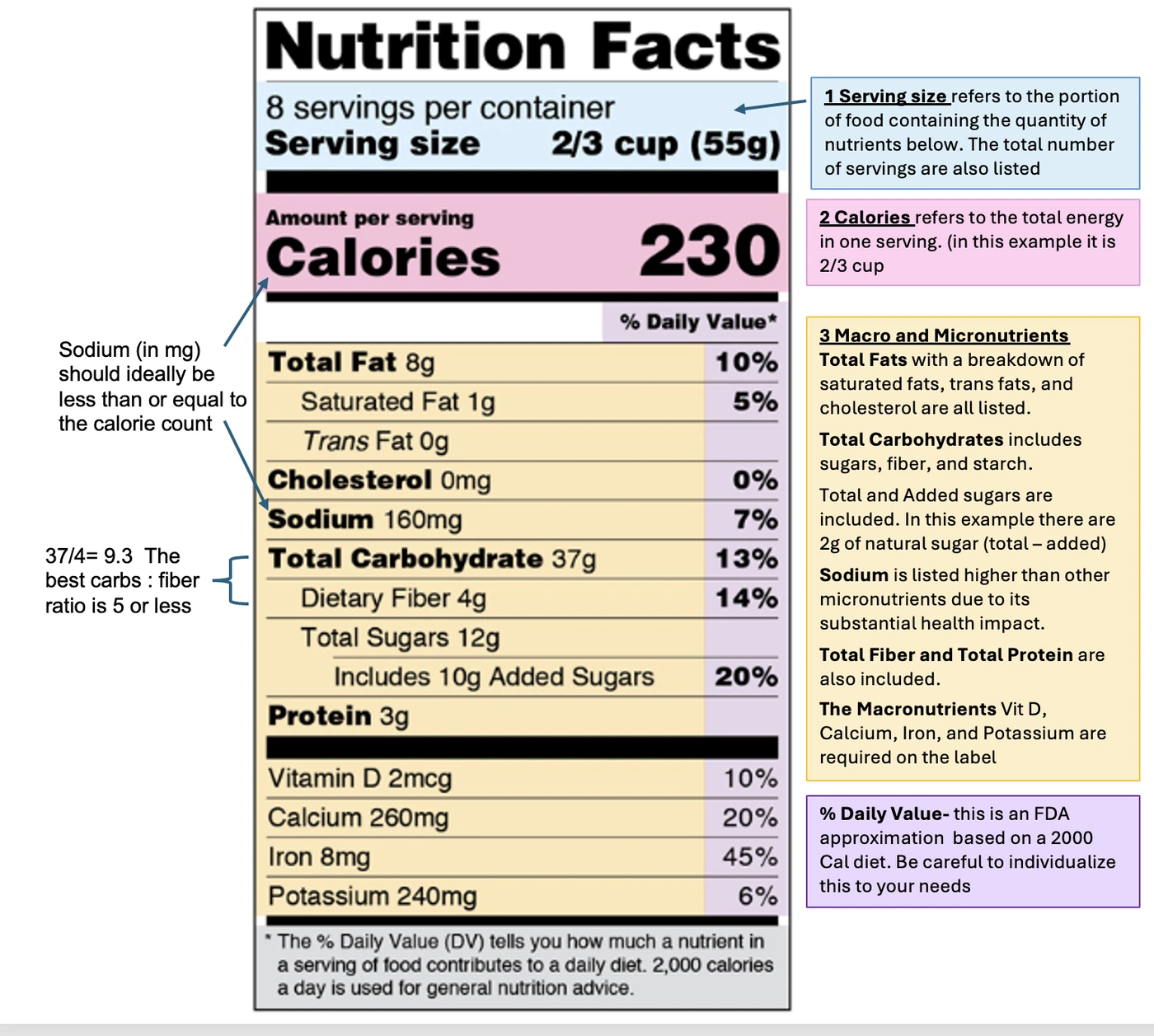
The Nutrition Facts label can look complicated and feel overwhelming at first, but most of the information you need can be organized into five main areas: serving size, calories, macronutrients and key micronutrients, Percent Daily Value (%DV), and the ingredient list. Once you understand what each of these tells you, reading a label becomes much faster and more intuitive. We will work through each of these areas individually, then bring them together into a simple strategy you can use when comparing foods.
Start With the Serving Size
The first place to look on a Nutrition Facts label is the serving size. This number provides the foundation for nearly everything that follows because the calories, fat, carbohydrates, protein, sodium, and other nutrients listed on the label generally refer to one serving, not necessarily the entire package or the amount you actually eat.
A serving size is the standardized amount used to calculate the nutrition information on the label. A portion is the amount you actually choose to eat. Those amounts may be very different. A package may contain more than one serving, and if you eat the entire package, your calorie and nutrient intake must be adjusted accordingly. For example, if a package contains three servings at 200 calories each, eating the entire package means consuming 600 calories, not 200. Serving size is usually expressed in familiar household measures (such as cups, tablespoons, pieces, or slices) along with its weight in grams. The label also tells you the number of servings per container, allowing you to quickly determine how many calories and nutrients you will consume if you eat more than one serving.
FDA labeling rules now require certain packages that people typically consume in one sitting to be labeled as a single serving. Other packages may display nutrition information both per serving and for the entire package.1 Even so, it is important to compare the serving size on the label with the amount you actually eat because, due to portion distortion, the serving size and the amount you actually eat are often not the same.
One of the most important things to understand is that serving size is not a recommendation for how much you should eat. Under FDA labeling rules, serving sizes are based on amounts that people typically consume at one eating occasion. In fact, some serving sizes have increased over time as eating patterns and portions have grown. This creates an important distinction: a serving size reflects customary consumption, not necessarily an ideal portion for health. As discussed in the previous chapter, what has become "normal" is not always the same as what is appropriate for your needs.2
Before focusing on any other number on the label, ask two simple questions: What is the serving size, and how much of this food am I actually going to eat? Once you know those answers, the rest of the Nutrition Facts label becomes much easier to interpret.
Understand Calories in Context
Calories measure the amount of energy a food provides, and the number listed on the Nutrition Facts label refers to one serving. If you eat more than one serving, you are consuming more than the amount shown on the label. How much energy you need also varies from person to person. Someone who exercises regularly or has high daily energy demands may need substantially more than someone who is smaller or less active. For that reason, the number on a label should not automatically be interpreted as "good" or "bad."
But calories tell you only how much energy a food provides, not how nutritious that food is. Two foods with a similar calorie count can differ dramatically in their amounts of protein, fiber, added sugars, fats, vitamins, minerals, and overall nutrient density. Likewise, a food with more calories is not necessarily less healthy than one with fewer.
The better approach is to consider calories in context. First determine how much of the food you are actually likely to eat, then ask what those calories are providing. Are they accompanied by protein, fiber, healthy fats, vitamins, or minerals? Or are they coming primarily from added sugars, refined carbohydrates, or other ingredients that provide calories with relatively few beneficial nutrients?
Clearly, calories matter. However, they are only one part of the nutritional picture. Rather than focusing solely on eating fewer calories, consider the nutritional value those calories provide. The previous chapter emphasized how much you eat. This chapter adds another important dimension by helping you understand the quality of what you eat. Together, these two perspectives can help you make more informed food choices.
Macronutrients That Matter
Macronutrients (fat, carbohydrates, and protein) make up much of the Nutrition Facts label and provide useful information about what a food actually contains. However, you do not need to scrutinize every number equally. The nutrients that deserve the most attention will depend partly on the food you are evaluating and your individual nutritional goals. For most packaged foods, a quick look at the type of fat, dietary fiber, added sugars, and protein can tell you a great deal.
Fat: The label lists total fat and provides separate amounts for saturated fat and trans fat. Total fat alone does not determine whether a food is healthy or unhealthy because the type of fat matters. Unsaturated fats (including monounsaturated and polyunsaturated fats) are generally the fats we want to emphasize, while saturated fat should generally be limited. Trans fats deserve particular attention because higher intake is associated with increased cardiovascular risk. Fortunately, artificial trans fats have now largely been removed from the U.S. food supply.3 Cholesterol is also listed separately on the label. We will explore dietary fats in much greater detail later, so for now the important lesson is simple: do not judge a food merely by how many grams of total fat it contains.
Carbohydrates: Total carbohydrate includes several different components, most importantly dietary fiber and sugars. These distinctions matter because 30 grams of carbohydrate from a fiber-rich whole-grain food is nutritionally very different from 30 grams coming largely from refined starch and added sugar.
Dietary fiber is particularly worth noticing. Foods that provide more fiber generally help promote satiety, often reflect better carbohydrate quality, and can help slow the digestion and absorption of carbohydrates, leading to a more gradual rise in blood glucose after a meal. When comparing breads, cereals, crackers, and other grain-based foods, looking at fiber alongside total carbohydrate can be more informative than looking at total carbohydrate alone.
The label also separates Total Sugars from Added Sugars. Total sugars include both sugars naturally present in foods and sugars added during processing. Added Sugars identifies the portion introduced during processing or preparation, including sugars from ingredients such as table sugar, syrups, and honey. This distinction is important because naturally occurring sugars are often found in foods that also provide protein, fiber, vitamins, minerals, or other beneficial nutrients, whereas added sugars contribute calories without necessarily providing additional nutritional benefits. A yogurt containing naturally occurring lactose, for example, should not be evaluated the same way as one containing a substantial amount of added sugar. When comparing similar products, choosing the one with less added sugar is often the better choice, particularly if the foods provide similar amounts of protein, fiber, and other beneficial nutrients.
Protein: Protein is straightforward on the label: it is listed in grams per serving. Protein needs vary considerably depending on body size, age, activity level, training, and individual goals, so there is no single amount that makes a particular food "high protein" for everyone. Instead, use the number to understand how much protein that food contributes to your overall intake. We will explore protein requirements and food sources much more thoroughly in a later chapter.
The most important lesson is not to evaluate any macronutrient in isolation. A food does not become healthy simply because it is low in fat, low in carbohydrates, high in protein, or labeled "zero sugar." Look at how the nutrients work together and consider what the food is actually providing. The Nutrition Facts label becomes far more useful when you use it to understand the overall nutritional profile of a food rather than focusing on a single number.
Pay Attention to Key Micronutrients
Micronutrients (vitamins and minerals) are needed in much smaller amounts than carbohydrates, fats, and protein, but they play essential roles throughout the body. The Nutrition Facts label does not list every vitamin and mineral a food contains. Instead, it highlights several nutrients that are particularly useful for consumers to monitor.
Vitamin D, calcium, iron, and potassium are routinely listed on the Nutrition Facts label. Their amounts are shown in milligrams (mg) or micrograms (mcg), along with the Percent Daily Value (%DV). These nutrients deserve attention because many people do not consume enough of them, and each plays an important role in maintaining health. Calcium and vitamin D support bone health, iron is essential for oxygen transport, and potassium contributes to normal nerve, muscle, and cardiovascular function.
Sodium is also prominently listed, although for a different reason. While sodium is an essential mineral, many packaged and processed foods contain substantial amounts of it. For people who consume a large proportion of their diet from these foods, sodium intake can accumulate quickly. Looking at the sodium content of similar products can therefore be particularly useful when comparing foods such as soups, sauces, breads, frozen meals, and snack foods. Certain individuals with medical conditions, such as high blood pressure, heart failure, or kidney disease, may need to pay even closer attention to nutrients such as sodium and potassium. If you have one of these conditions, follow the recommendations provided by your healthcare professional.
Other vitamins and minerals may also appear on the label. Nutrients such as vitamin A, vitamin C, magnesium, zinc, and several B vitamins can be listed voluntarily, and manufacturers may provide additional information when a food is fortified or when they make a specific nutrient claim.
As with the macronutrients, no single micronutrient tells you whether a food is healthy. Instead, use this part of the label to understand what the food contributes to your overall diet. A food that provides meaningful amounts of vitamins or minerals may offer additional nutritional value, but those numbers should still be considered alongside the food's ingredients, macronutrients, serving size, and overall quality. The presence of a particular vitamin or mineral does not automatically make a food healthy; what matters is the overall nutritional profile.
In the next section, we'll explore how Percent Daily Value (%DV) can help you quickly determine whether a food provides relatively small or large amounts of particular nutrients.
Understand Percent Daily Value
The Percent Daily Value (%DV) is probably one of the most misunderstood parts of the Nutrition Facts label. While it can be useful, it is not a number you need to focus on for every food you eat. Think of it as a quick comparison tool rather than something you need to optimize or memorize.
The Percent Daily Value tells you how much a nutrient in one serving contributes to the established Daily Value for that nutrient. Daily Values are established by the U.S. Food and Drug Administration (FDA) as standardized reference amounts, with 2,000 calories per day used for general nutrition guidance. Because individual needs vary with factors such as age, sex, body size, activity level, and health goals, %DV should be viewed as a practical reference point rather than a personalized nutritional prescription.
The FDA uses a simple rule of thumb:
- 5% DV or less is considered low
- 20% DV or more is considered high
These values are not magic numbers, but they provide a quick way to judge whether a food contains relatively little or relatively much of a particular nutrient. In practice, %DV is most useful when comparing similar products. If two breads, cereals, soups, or frozen meals have similar serving sizes, the %DV column allows you to quickly see which provides more fiber, calcium, vitamin D, iron, or potassium, or less saturated fat, sodium, and added sugar. When serving sizes differ, however, comparisons become less meaningful, so always compare serving sizes first.
Not every item on the Nutrition Facts label has a %DV. For example, total sugars do not have an established Daily Value, while added sugars do. Trans fat also does not have a %DV. This is another reminder that no single column or number should be used to judge the overall nutritional quality of a food.
Ultimately, %DV is best viewed as a guide rather than a goal. It provides a standardized way to compare similar foods, but it should always be interpreted alongside the serving size, calories, macronutrients, micronutrients, ingredient list, and your own individual nutritional needs.
Read the Ingredient List
The Nutrition Facts label tells you how much of various nutrients a food contains. The ingredient list tells you what those nutrients are actually coming from. Used together, these two sources of information provide a much clearer picture than either one alone.
Ingredients are listed in descending order by weight, which means the ingredient present in the greatest amount appears first, followed by the next most abundant ingredient, and so on. For that reason, the first several ingredients often tell you a great deal about the overall composition of the food.
This can be especially helpful when evaluating products that make appealing claims on the front of the package. A bread may advertise that it is "made with whole grains," for example, but the ingredient list may reveal that refined flour is actually the predominant ingredient and whole grain appears much farther down the list. Similarly, a product advertised as containing fruit or vegetables may contain only a relatively small amount once you look at where those ingredients appear.
When evaluating grain-based foods, look for ingredients such as “whole wheat flour,” “whole grain oats,” or other clearly identified whole grains near the beginning of the ingredient list. Words such as "wheat," "multigrain," or "made with whole grains" do not necessarily mean that most or all of the grain in the product is whole grain. The ingredient list often provides a more complete picture than the claims displayed on the front of the package.
The ingredient list is also useful for identifying added sugars, oils, preservatives, flavorings, thickeners, colors, and other ingredients that may not be obvious from the front of the package. This does not mean that every unfamiliar ingredient is harmful or that every processed ingredient should be avoided. Many ingredients serve legitimate purposes, including maintaining freshness, improving texture, preventing spoilage, or fortifying foods with vitamins and minerals.
Likewise, the number of ingredients by itself is not a reliable measure of nutritional quality. A food with three ingredients is not automatically healthier than one with fifteen, and a longer ingredient list does not necessarily mean that a food is unhealthy. Do not simply count the ingredients. Understand what the major ingredients are and why they are there.
Finally, remember that ingredient claims highlighted on the front of a package are not a substitute for the complete ingredient list. The front of the package is designed, in part, to attract your attention. When you really want to know what a food contains, turn the package around and read the complete ingredient list. It often clarifies what the marketing claims alone do not. With practice, this doesn't need to take long. A quick glance at the first several ingredients, together with the Nutrition Facts label, can help you understand what makes up most of the product and whether it matches the impression created by its packaging.
Look Beyond Front-of-Package Marketing
Food packaging is designed to attract attention, and the front of the package is often where manufacturers place the most appealing claims. Words such as “natural,” “multigrain,” “made with whole grains,” “high protein,” “low fat,” “no cholesterol,” or “made with real fruit” can create the immediate impression that a product is healthy. Sometimes that impression is justified. Other times, the claim is technically true but tells only a small part of the story.
That is why it is important to distinguish between marketing language and nutritional information. The front of the package is designed to capture your attention and influence your purchasing decisions. The Nutrition Facts label and ingredient list are designed to tell you what the product actually contains.
Consider the phrase “made with whole grains.” A product can contain some whole grain and still be made predominantly from refined grains. Similarly, “multigrain” simply means that more than one type of grain is present. It does not necessarily mean those grains are whole grains. In contrast, a product labeled “100% whole wheat” generally indicates that all the wheat flour used is whole wheat rather than refined wheat flour. This is a more meaningful claim, although it still doesn't tell you everything about the product's nutritional quality. The ingredient list is where you can determine which grains are present in the greatest amounts.
The same principle applies to claims such as “made with real fruit” or “made with vegetables.” The presence of fruit or vegetables does not tell you how much of the product they represent. If those ingredients appear farther down the ingredient list, they may make up only a small proportion of the food.
The word “natural” can also create a powerful health halo. Many consumers interpret it to mean healthier, less processed, or nutritionally superior, but the term itself has no consistent nutritional meaning. A food labeled “natural” can still be high in added sugar, saturated fat, sodium, or calories. Rather than relying on a single marketing claim, use the Nutrition Facts label and ingredient list to determine whether a food actually fits your nutritional goals.
Another common example is “no cholesterol.” Cholesterol is found only in animal-derived foods, so plant-based foods such as vegetable oils, nuts, seeds, and peanut butter naturally contain no cholesterol. Highlighting “no cholesterol” on these products may be factually accurate, but it can make an ordinary characteristic of the food sound like a special nutritional advantage.
Front-of-package claims are not necessarily false, and some provide genuinely useful information. However, their purpose is also to help market the product. The key is not to let a single claim determine your impression of the entire food. A product can be “high protein” and still contain substantial added sugar. It can be “low fat” and still be highly refined. It can be “made with whole grains” while containing mostly refined flour.
A simple habit can prevent much of this confusion: when a claim on the front of the package catches your attention, turn the package around and verify it. Check the serving size, Nutrition Facts label, and ingredient list before deciding what that claim actually means. The front of the package may catch your attention, but the back of the package, when interpreted correctly, tells the more complete story.
Common Nutrition Label Myths and Misconceptions
Nutrition labels provide valuable information, but they are also surrounded by common myths and misconceptions. Understanding a few of these can help you make more informed food choices and avoid being misled by oversimplified nutrition messages.
"Brown sugar is healthier than white sugar."
Brown sugar contains small amounts of molasses, which gives it its color and flavor, but the nutritional differences between brown and white sugar are minimal. From a health perspective, both should be consumed in moderation.
"Honey, maple syrup, or agave syrup are healthy alternatives to table sugar."
These sweeteners are often perceived as healthier because they are naturally derived and may contain small amounts of vitamins, minerals, or plant compounds. However, they are still concentrated sources of sugar and calories. While there are some differences among these sweeteners, they should all be used in moderation. We'll discuss added sugars and sweeteners in greater detail in a later chapter.
"High-fructose corn syrup is much worse than table sugar."
High-fructose corn syrup and table sugar have very similar compositions. Table sugar (sucrose) is made up of approximately 50% glucose and 50% fructose, while the form of high-fructose corn syrup commonly used in soft drinks contains approximately 45% glucose and 55% fructose. Despite its name, high-fructose corn syrup is therefore not dramatically higher in fructose than table sugar, and the two produce generally similar metabolic effects when consumed in comparable amounts.4 The larger concern is not one type of sugar versus another, but consuming excessive amounts of added sugars from any source. High-fructose corn syrup is commonly found in highly processed foods and sugar-sweetened beverages, which are often associated with less healthy dietary patterns. We'll revisit this topic when we discuss ultra-processed foods.
"If a food is low in fat, it must be healthier."
Not necessarily. Some reduced-fat products replace fat with added sugars, refined starches, or other ingredients to improve taste and texture. Rather than focusing on a single nutrient, consider the overall nutritional profile of the food. We'll explore dietary fats and their role in health in a later chapter.
"Organic" or "Non-GMO" means healthier.
These labels describe how a food is produced, not necessarily its nutritional quality. An organic cookie is still a cookie, and an organic soft drink can still contain added sugar. These distinctions may be important for other reasons, but they should not replace reading the Nutrition Facts label and ingredient list.
"A long ingredient list means a food is unhealthy."
Not always. Some nutritious foods contain multiple ingredients, particularly fortified foods or products made from several whole-food ingredients. The number of ingredients by itself tells you very little about the nutritional quality of a food. Focus less on how many ingredients are listed and more on what those ingredients are and why they are included.
"If an ingredient sounds artificial or unfamiliar, it must be unhealthy."
Not necessarily. Food additives can serve useful purposes, including preserving freshness, preventing spoilage, improving texture, maintaining color, and enhancing flavor. An unfamiliar or chemical-sounding name does not automatically mean that an ingredient is harmful. At the same time, the ingredient list can help you identify artificial colors, flavors, sweeteners, preservatives, and other additives you may choose to limit. Rather than judging a food simply by whether an ingredient sounds "natural" or "artificial," consider its purpose and the overall nutritional quality of the product.
"One nutrition claim tells me everything I need to know."
A product may be "high protein," "low fat," "gluten-free," "organic," or "made with whole grains" and still be high in added sugar, sodium, saturated fat, or refined carbohydrates. No single claim determines whether a food is healthy. Always evaluate the Nutrition Facts label and ingredient list as a whole.
The most common mistake people make is focusing on one number or one marketing claim while overlooking the rest of the label. Rather than searching for a single indicator of a healthy food, use what you've learned to look beyond individual claims and understand what the product actually provides. The goal is not to find a perfect food, but to make a more informed choice based on the complete nutritional picture.
Nutrition Detective: Looking Beyond the Front of the Package
Let's put these lessons into practice with an example. The front of a package creates a first impression, but the Nutrition Facts label and ingredient list provide a more complete picture.
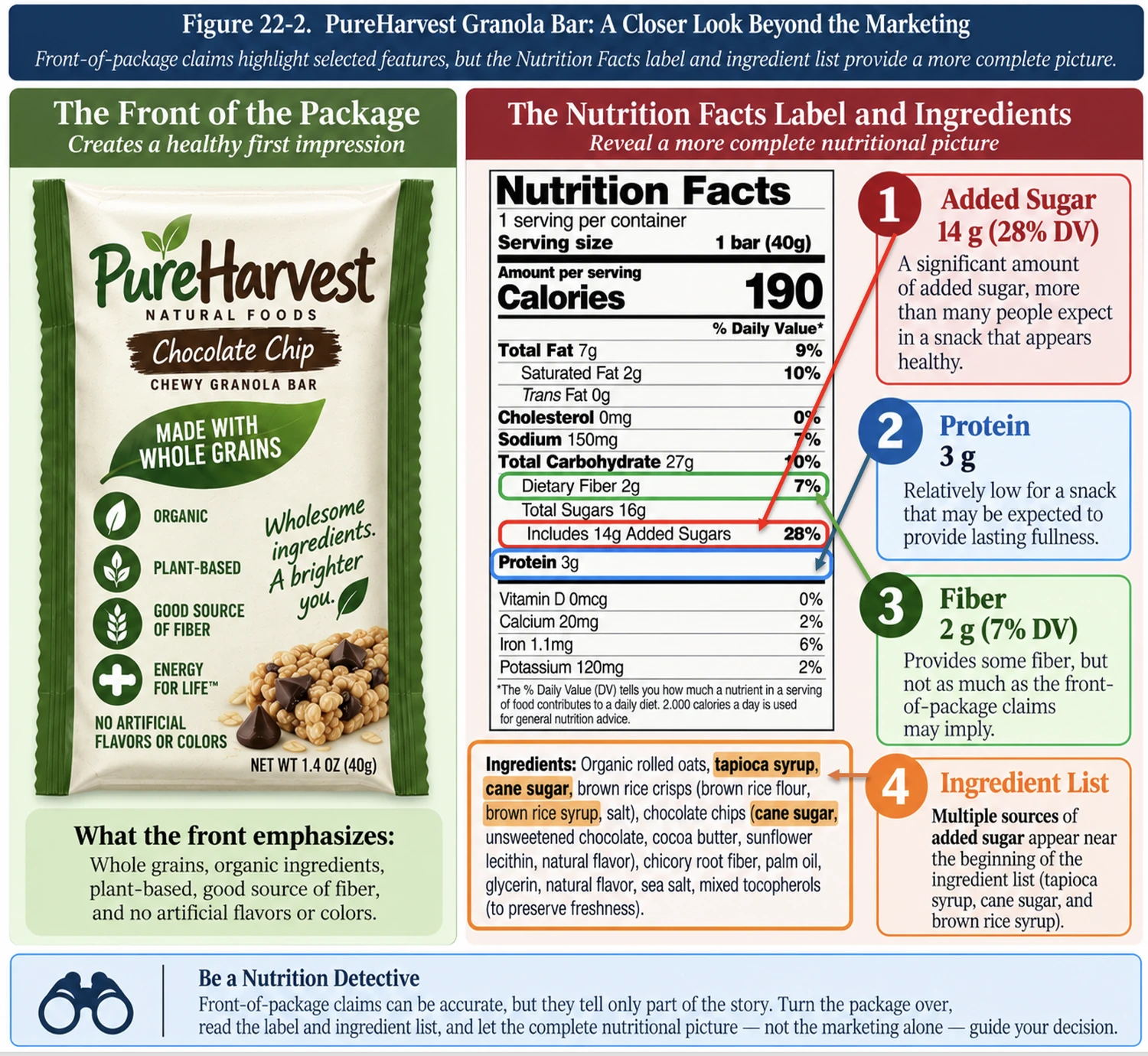
At first glance, PureHarvest Chocolate Chip Chewy Granola Bar appears to be a wholesome choice. The front of the package emphasizes claims such as Made with Whole Grains, Organic, Plant-Based, Good Source of Fiber, and No Artificial Flavors or Colors, while its earthy colors and natural imagery reinforce a healthy image.
After turning the package over, however, a more complete nutritional picture emerges. Although the bar contains whole grains and some fiber, it also provides 14 grams of added sugar, only 3 grams of protein, and 2 grams of fiber. The ingredient list also reveals multiple sources of added sugar near the beginning of the list. The lesson is not that this is a "bad" food or that the front-of-package claims are false. Rather, those claims emphasize certain characteristics without necessarily reflecting the product's overall nutritional profile. The next time a package catches your attention, be a nutrition detective: turn it over, read the label, and let the complete nutritional picture—not the marketing alone—guide your decision.
A Simple Strategy for Comparing Foods
Reading a Nutrition Facts label does not have to be complicated. In most situations, you can evaluate a food in less than a minute by following a simple sequence.
| Step | What to Look For | What to Ask Yourself |
|---|---|---|
| 1. Start with the serving size | Look at the serving size and servings per container. | How does the serving size compare with the amount I am actually going to eat? |
| 2. Look at the calories | Consider how much energy one serving provides. | Does this amount make sense for my needs and for this type of food? |
| 3. Scan the macronutrients | Pay particular attention to protein, dietary fiber, added sugars, saturated fat, and, when appropriate, total fat. | What am I getting in return for those calories? |
| 4. Check sodium and key micronutrients | Look at sodium, calcium, iron, potassium, and vitamin D as relevant to your nutritional needs. | Are there nutrients I want more or less of? |
| 5. Read the ingredient list | Look at the first several ingredients to see what makes up most of the product. | Does the ingredient list match the impression created by the front of the package? |
| 6. Put it all together | Consider the entire nutritional picture rather than focusing on one number or claim. | Overall, does this food fit my nutritional goals? |
A practical six-step framework for quickly comparing packaged foods. Start with serving size, then consider calories, key nutrients, and the ingredient list together rather than relying on any single number or front-of-package claim.
Remember, the purpose of reading a nutrition label is not to find the "perfect" food. It is to make a better-informed decision than you would have made without looking. Small improvements made consistently over time are far more important than finding a product with a perfect label.
For the next seven days, make it a habit to read the Nutrition Facts label and ingredient list before purchasing or eating at least one packaged food each day. Don't worry about analyzing every number on the label. Instead, focus on practicing the simple process you learned in this chapter.
As you look at each product, ask yourself these questions:
- What is the serving size, and how much am I actually going to eat?
- How many calories does that amount provide?
- Does it contain a reasonable amount of protein and dietary fiber?
- How much added sugar and saturated fat does it contain?
- Do the micronutrients align with my needs and goals?
- What are the first several ingredients?
- Do the Nutrition Facts label and ingredient list support the claims on the front of the package?
You do not need to choose the "perfect" food every time. The goal is simply to become more aware of what you are buying and eating. If you compare two similar products and make a slightly better choice, you've successfully practiced the habit.
By the end of the week, reading a Nutrition Facts label should begin to feel more familiar and less intimidating. What may have once looked like a confusing collection of numbers can become a practical tool that helps you make more informed decisions with confidence. Just as importantly, you will begin to look beyond the claims on the front of the package and recognize that they often tell only part of the story.
Learning to read a Nutrition Facts label is one of the simplest skills you can develop to make healthier food choices. It does not require expensive equipment, special training, or hours of study. It simply requires taking a few moments to look beyond the marketing and understand what you are actually buying and eating.
No single number, ingredient, or claim tells the whole story. Serving size, calories, macronutrients, micronutrients, Percent Daily Value, and the ingredient list each provide one piece of the puzzle. When considered together, they offer a much clearer picture of a food's nutritional quality than any one number or marketing claim ever could.
Remember, the purpose of reading a nutrition label is not to find the "perfect" food or to analyze every package with scientific precision. It is to make more informed decisions. Over time, those small, consistent decisions accumulate into healthier eating patterns that can have a meaningful impact on your overall health.
The next time you pick up a packaged food, resist the temptation to let the front of the package make the decision for you. Turn it over. Read the label. Understand what it is telling you. Then make the choice that best aligns with your health goals. With practice, this simple habit can become second nature, helping you look beyond the marketing, take greater control of your food choices, and move toward becoming a healthier version of yourself, one choice and one habit at a time.
References
- Food Labeling: Revision of the Nutrition and Supplement Facts Labels. Final rule. Fed Regist. 2016;81(103).
- Rolls BJ, Morris EL, Roe LS. Portion size of food affects energy intake in normal-weight and overweight men and women. American Journal of Clinical Nutrition. 2002;76(6).
- Mozaffarian D, Katan MB, Ascherio A, Stampfer MJ, Willett WC. Trans fatty acids and cardiovascular disease. Obstet Gynecol Surv. 2006;61(8).
- White JS. Straight talk about high-fructose corn syrup: What it is and what it ain’t. American Journal of Clinical Nutrition. 2008;88(6).