
Metabolic Health
Three Windows Into Glucose Regulation and Metabolic Health
HbA1c: A Window into Glucose Control and Long-Term Health
Hemoglobin A1c (HbA1c) reflects average blood glucose exposure over approximately the previous 2 to 3 months. It is commonly used to help identify prediabetes and diabetes. But it can also provide broader context about metabolic health.
HbA1c is best understood as a continuum. Diagnostic cutoffs are clinically useful, but risk does not suddenly appear at one number and disappear just below it.
HbA1c reference ranges
| HbA1c | Clinical interpretation |
|---|---|
| <5.7% | Normal range |
| 5.7–6.4% | Prediabetes |
| ≥6.5% | Diabetes* |
Fasting plasma glucose
| Fasting glucose | Clinical interpretation |
|---|---|
| <100 mg/dL | Normal |
| 100–125 mg/dL | Prediabetes |
| ≥126 mg/dL | Diabetes* |
*Diagnostic results are interpreted in clinical context and generally require confirmation when hyperglycemia is not unequivocal.
HbA1c and mortality risk
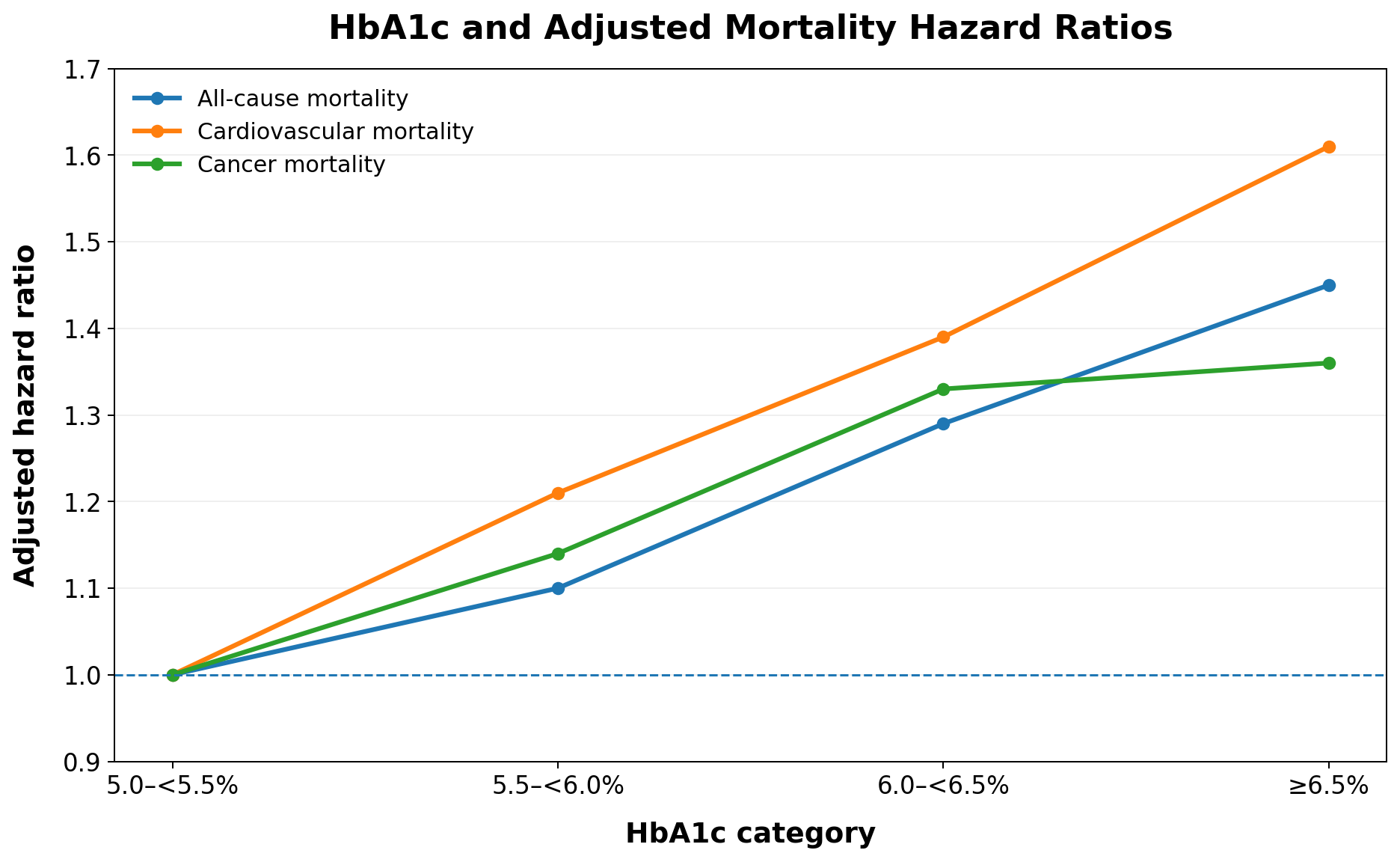
A 2011 prospective analysis followed 17,196 adults without known diabetes or cardiovascular disease for an average of 11.2 years. The investigators examined HbA1c in relation to all-cause, cardiovascular, and cancer-related mortality.1
Mortality risk was relatively flat at HbA1c levels lower than 5.5% and then increased as HbA1c rose, with the strongest association seen for cardiovascular mortality.
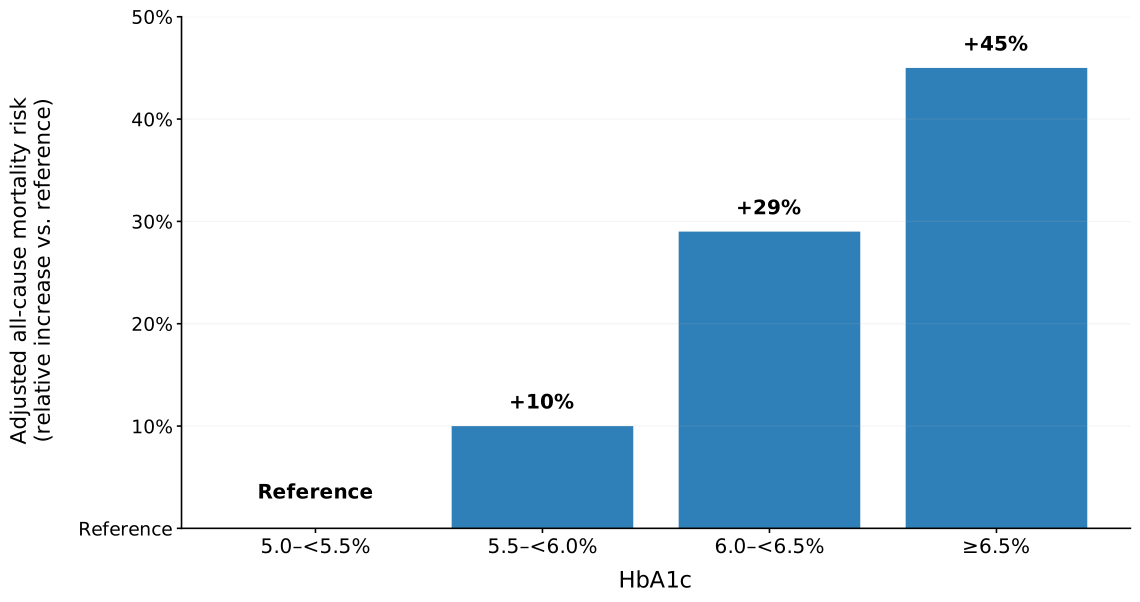
Adjusted hazard ratios by HbA1c category
| HbA1c | All-cause mortality HR | Cardiovascular mortality HR | Cancer mortality HR |
|---|---|---|---|
| 5.0–<5.5% (Reference) | 1.00 | 1.00 | 1.00 |
| 5.5–<6.0% | 1.10 | 1.21 | 1.14 |
| 6.0–<6.5% | 1.29 | 1.39 | 1.33 |
| ≥6.5% | 1.45 | 1.61 | 1.36 |
HR = hazard ratio. An HR of 1.20 means a 20% higher relative hazard compared with the reference group; an HR of 0.90 means a 10% lower relative hazard. These are relative associations, not absolute risks.
Key takeaways
- HbA1c reflects average glucose exposure over roughly 2 to 3 months.
- Diagnostic categories are useful, but HbA1c exists on a continuum.
- In this large non-diabetic cohort, mortality risk began to rise around the mid-5% range and increased further at higher HbA1c levels.
- The association was strongest for cardiovascular mortality.
- These findings show association, not proof that lowering HbA1c alone directly lowers mortality.
Practical perspective:Improve glucose regulation, not the number
The goal is not to chase the lowest possible HbA1c. It is to build habits that support healthy glucose regulation over time. Regular physical activity, improved body composition, better nutrition, adequate sleep, and reducing long periods of uninterrupted sitting can all contribute to better metabolic health.
Why does activity after a meal help? When skeletal muscle contracts, it can increase glucose uptake through pathways that do not depend entirely on insulin. Muscle contraction promotes movement of GLUT-4 glucose transporters to the muscle-cell surface, allowing circulating glucose to enter the muscle and be used for energy or stored for later. This is one reason even relatively brief walking or light activity after eating can help blunt the rise in post-meal blood glucose.
The timing and frequency of activity may matter as well. In older adults at risk for impaired glucose tolerance, three 15-minute walks performed after meals improved 24-hour glycemic control and were particularly effective at reducing post-meal glucose compared with a single sustained 45-minute walk.2 More recently, a 2024 randomized crossover study of 18 overweight or obese men found that interrupting 8.5 hours of sitting with brief walking or squat breaks every 45 minutes reduced post-meal glucose exposure more than uninterrupted sitting and more than a single 30-minute walk.3 These studies measured short-term glucose responses rather than long-term HbA1c, but they reinforce a practical message: moving after meals and breaking up prolonged sitting can help improve glucose regulation.
References
- Pfister R, Sharp SJ, Luben R, Khaw KT, Wareham NJ. No evidence of an increased mortality risk associated with low levels of glycated haemoglobin in a non-diabetic UK population. Diabetologia. 2011;54:2025–2032. doi:10.1007/s00125-011-2162-0.
- DiPietro L, Gribok A, Stevens MS, Hamm LF, Rumpler W. Three 15-min bouts of moderate postmeal walking significantly improves 24-h glycemic control in older people at risk for impaired glucose tolerance. Diabetes Care. 2013;36:3262–3268. doi:10.2337/dc13-0084.
- Gao Y, Li QY, Finni T, Pesola AJ. Enhanced muscle activity during interrupted sitting improves glycemic control in overweight and obese men. Scand J Med Sci Sports. 2024;34:e14628. doi:10.1111/sms.14628.